
The answer: pull once, lift by hand, close it carefully
When the power goes, an automatic garage door with no backup battery stays where it stopped. The red cord hanging from the opener is how you take over. Merlin's manual release guide says all its openers have one for power outages: pull the cord down firmly once, listen for the click, then walk to the door and push it up by hand.
This storm season shows why that matters. Ausgrid, whose network covers Sydney, the Central Coast and the Hunter Valley, cites weather experts: above-average temperatures and warmer ocean conditions "could see more severe weather across eastern NSW during spring and summer". Ausgrid adds that "Strong winds, heavy rain and thunderstorms can damage electrical infrastructure, bring down trees and powerlines". NSW SES says a severe storm can "impact the supply of essential services like electricity".
Further north, the Queensland Government's cyclone and severe storm page describes a category 2 cyclone as carrying a "risk of power failure", category 3 as "power failure likely" and category 4 as bringing "widespread power failures". The bureau's outlook, as reported by the ABC, gives Queensland an increased chance of a severe cyclone, category 3 or above, this season. The same report points to warmer Coral Sea waters and cyclones possibly moving further south.
| Category | Power |
|---|---|
| Category 2 | "risk of power failure" |
| Category 3 | "power failure likely" |
| Category 4 | "widespread power failures" |
Source: Queensland Government, cyclone and severe storm
Bureau outlook as reported: increased chance of a severe cyclone (category 3 or above) in Queensland this season.
Source: ABC News, 6 October 2026
You don't need a cyclone overhead to be caught, though. Any storm that drops a line leaves an electric door stuck. At Levee Garage Doors our view is simple: everyone in the house who uses the garage should have pulled that cord at least once, in daylight, before they ever need to.
Where is the manual release on my garage door?
Roller door
Sectional or tilt door
Source: Merlin, manual release guide
It depends on the door. On roller doors, the motor sits at one side of the opening. On sectional and tilt doors, the motor is in the middle of the ceiling and the red cord hangs from the steel rail, according to Merlin's manual release guide.
The same guide suggests the whole household knows where the cord is, and that you check it regularly: it should not be frayed and should still have its plastic handle. A cord that has lost its handle is hard to grab in the dark. If you have never spotted yours, our guide to finding the red cord walks you through it.
How do I use the manual release?
-
1Pull the cord down once
-
2Lift the door by hand
-
3Close it carefully
-
4Re-engage when the power is back
-
5Test it
The sequence is short. Do it slowly the first time.
- Pull the cord down once. Pull firmly until the opener clicks. Both Merlin's guide and B&D's sectional door how-to describe the click as your sign the door is free.
- Lift the door by hand. Hold the door itself, not the cord.
- Close it carefully. B&D's steps say to close the door carefully to secure it once you are through.
- Re-engage when the power is back. Here the brands differ. Merlin's guide says to pull the red cord down firmly. B&D's sectional door how-to says to pull the cord away from the door until it clicks, and the pin returns to horizontal.
- Test it. B&D suggests checking with the remote, wall button or phone.
Step 4 is the reason to keep your opener's manual somewhere you can find it. Where two makers word it differently, yours is the one that counts.
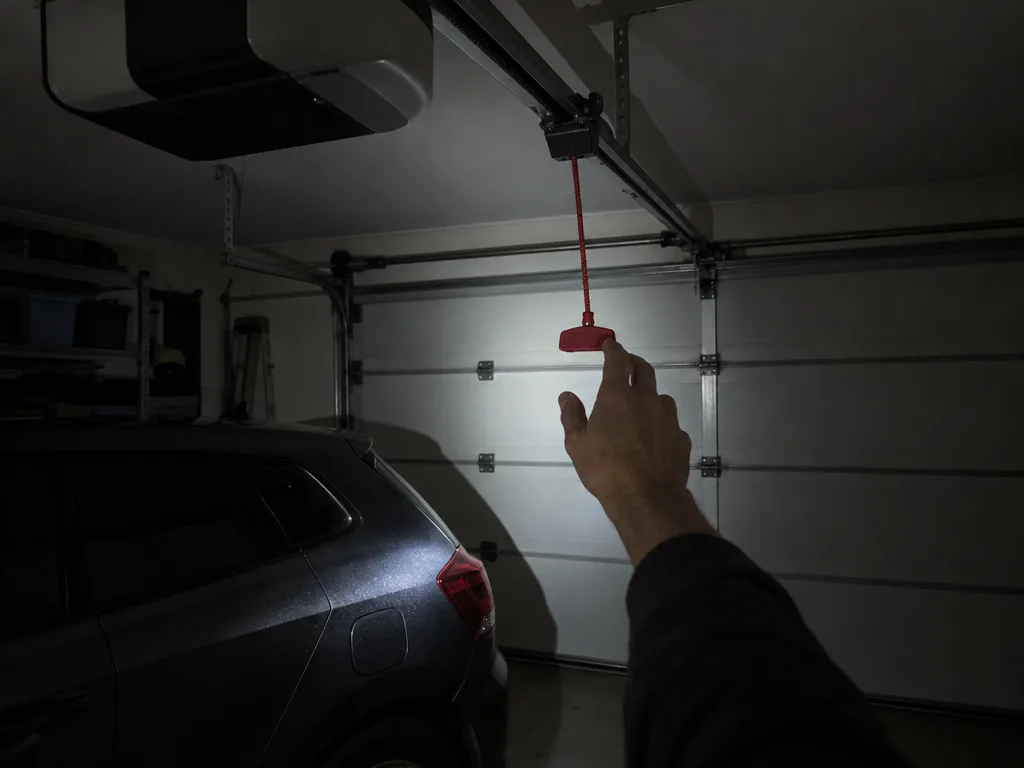
Is it safe to release the door when it's open?
"Do not try to pull the door using the manual release cord; it will snap under the load."
Release it closed if you can. If the door was already stuck, crooked or straining before the power went, leave the cord alone and get the door looked at: a weak or broken spring may not hold its weight. Merlin's guide warns that an open door may fall rapidly when released if its springs are weak or broken. B&D's steps say to lift the door by hand, "taking extra care if the door is open or ajar".
If the power fails with the door up, keep children, pets and the car out from underneath it before anyone touches the cord. And never use the cord as a handle. Merlin puts it bluntly: "Do not try to pull the door using the manual release cord; it will snap under the load."
Do I need to switch the power off before pulling the cord?
- Recall number
- PRA 2002/5134
- Product
- Garage door opener for rolling type doors, Model 305, sold as Controll-A-Door 5 (CAD5), Easylifter and Firmamatic
- Made
- August 1999 to March 2000
- Reason
- Disengagement cable may touch live components; circuit board cover may not block live parts
- Advice
- Remote only until repaired; power off before manual disengaging; don't push the cable up into the unit or prise the cover
- Pull the red cord down until it clicks
- Lift the door by hand
- Take extra care if the door is open
Among the sources we checked, the advice to turn the power off before manually releasing an opener appears in a 2002 product recall covering one older rolling-door model, and it is not a rule for every opener.
That recall had a specific reason: the disengagement cable may touch live components, and the circuit board cover may not block access to live parts. Its advice was to run the unit by remote only until repaired, switch off before disengaging, and never push the cable up into the unit or prise open the cover. If your opener matches the models and manufacture dates on that recall listing, follow the recall.
For other openers, the current steps from the two makers we checked, Merlin and B&D, say to pull the cord and lift the door, with no step to switch the power off first. Your own opener's manual is the rule that applies to your door.
What if the door won't move after I release it?
- the door was stuck, crooked or straining before the power went: don't pull the cord
- the door feels heavy or uneven
- it jams or looks damaged
- it won't hold its position once released
- the cord is frayed or missing its plastic handle
- the opener won't re-engage, or the door still misbehaves after re-engaging
Stop. Don't force it. A door that feels heavy, sits crooked, jams or won't hold its position once released is telling you something is wrong with its balance or hardware, and that is not a job for a blackout and a torch.
B&D's own guidance says a door that still misbehaves after these steps may need a professional service, and that repair and servicing "should only be provided by a trained professional". Leave the springs, cables and brackets alone, use another exit, and call a technician once it's safe.
The same goes for a cord that is frayed or missing its handle, or an opener that won't re-engage when the power comes back.
Can I get in if my garage has no side door?
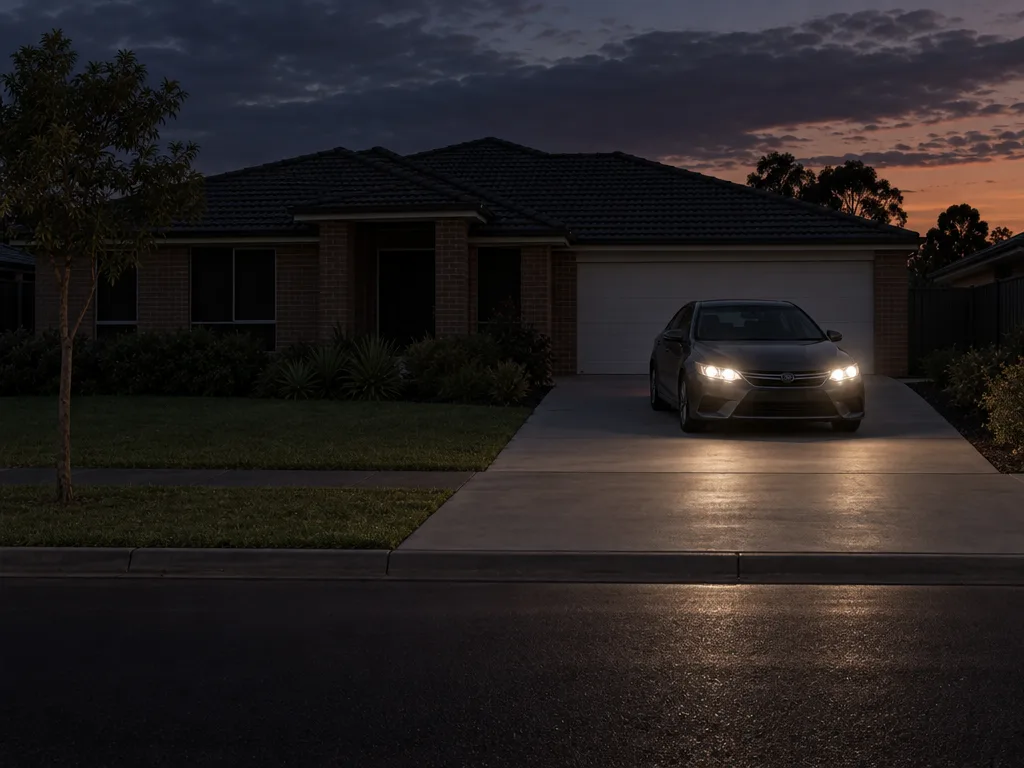
This is the case that catches people out. If the only way into the garage is the door itself, the red cord is on the wrong side of it when you're standing in the driveway.
For garages without a second access point, Merlin sells a Key Operated Manual Release (E1702M) that lets you disengage the opener from outside during a blackout or remote failure. Compatibility is limited to listed Merlin models, so check yours against the list before relying on it. If you have a different brand, ask about an outside release for your own opener.
Will a backup battery keep the door working in a blackout?
1 cycle = one lift and one lower
Usually 2 to 4 full cycles (B&D's figures for its own Battery Backup)
Starts automatically when power is lost, recharges when power returns
It can buy you a few trips. B&D says its Battery Backup starts automatically when power is lost and recharges when it returns. It says you usually get two to four full cycles, where one lift and lower counts as one cycle, and that the battery suits all B&D sectional door automatic openers with a one-year warranty.
What does that mean on the night? Our estimate: driving out (door up, door down) is one cycle and coming home is another, so two to four cycles works out to one or two round trips. Those are one maker's figures for its own battery; other brands will differ, so check yours.
A battery doesn't replace knowing the cord. Merlin's blackout advice lists three steps: know the cord, consider a backup battery, and keep the driveway clear for a quick exit. Add the basics to your kit too. Ausgrid says to "Keep a battery-operated torch, radio and spare batteries handy", and NSW SES says every home should have an emergency kit for when "there is no electricity or running water". After a storm, treat any fallen powerline as live: Ausgrid says to "stay at least eight metres, or two car lengths away" and report it on 13 13 88.
Your five-minute rehearsal before the storms
Pick a dry afternoon with the door closed and the whole household home. Find the cord together. Check it for fraying and make sure the handle is on. Pull it once, hear the click, lift the door by hand and lower it gently. Re-engage it the way your manual says, then test with the remote.
Five minutes. Then everyone knows what the click sounds like, how heavy the door feels, and which way the cord goes back.
If you want a quick read on the rest of the door while you're out there, our Readiness Gauge runs through five checks.
- 1Pull the cord once
- 2Hear the click
- 3Lift by hand
- 4Close carefully
- 5Re-engage
- 6Test with remote, wall button or phone
If the cord or the door isn't right, tell us now
Rehearsals are where problems show up: a frayed cord, a door that drops or drags, an opener that won't take the door back. Better to find that on a calm afternoon than in a storm.
If anything in your rehearsal felt wrong, tell Levee Garage Doors what the door is doing through our enquiry page, and we'll take it from there.
Sources
- https://www.qld.gov.au/emergency/dealing-disasters/disaster-types/cyclone-severe-storm
- https://www.abc.net.au/news/2026-10-06/qld-severe-weather-outlook/107232308
- https://www.gomerlin.com.au/blog/operate-manual-release-garage-door/
- https://www.bnd.com.au/support/resources-for-owners/how-to-guide/how-to-manually-open-a-bd-sectional-garage-door/
- https://www.productsafety.gov.au/search-consumer-product-recalls/garage-door-openers
- https://www.gomerlin.com.au/product/key-operated-manual-release/
- https://www.bnd.com.au/garage-doors/options-and-upgrades/safety-security-upgrades/battery-back-up/
- https://www.gomerlin.com.au/blog/how-to-safely-enter-and-exit-your-garage-during-blackouts-this-summer/
- https://www.ausgrid.com.au/about-us/newsroom/get-storm-ready
- https://www.ausgrid.com.au/about-us/about-ausgrid/what-we-do
- https://www.ses.nsw.gov.au/during-emergency/during-storm
- https://www.ses.nsw.gov.au/plan-and-prepare/emergency-kit