
Owner's guide · the flats · EL 10–25 m
River damp and your door: what the flats do to steel.
Maitland's older belt sits low: the CBD at roughly 14 metres, Morpeth at 15, Telarah and the Bolwarra flats close behind, all of it within reach of the Hunter's morning air. This is not the coast; there is no salt spray to blame. What the flats have instead is patience: fog off the river, dew that sits late on south-facing doors, and around 922 millimetres of rain in an average year. Steel notices.
Where it shows first: the reading order
Damp does not attack a door evenly. It works in a reliable order, which means you can read a door on the flats the way you read a gauge: the stage tells you the level.
1. The weather seal goes quiet
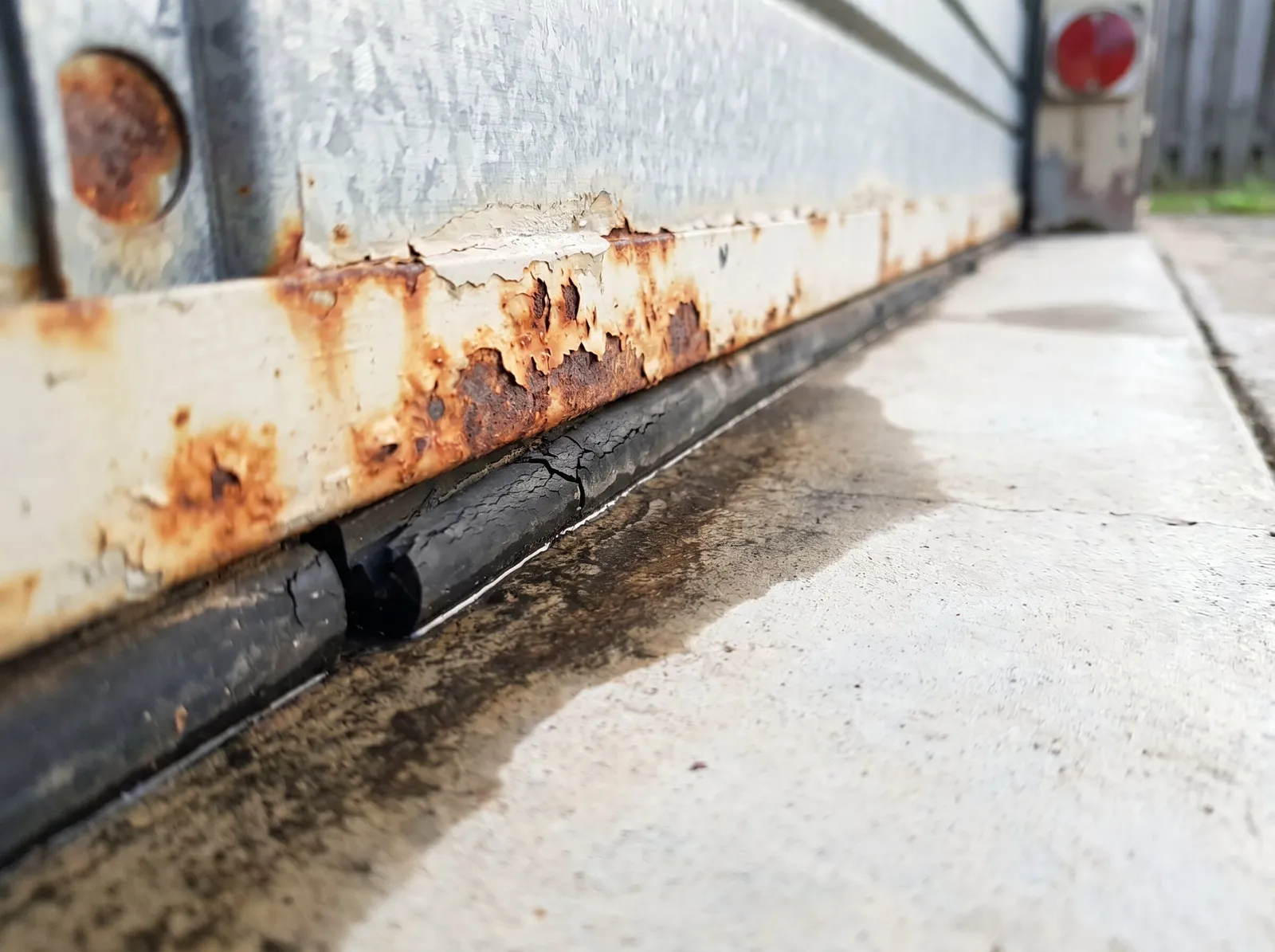
The rubber seal along the bottom of the door does its work invisibly until it cracks, flattens or lifts. Once daylight shows under a closed door, the slab behind it starts staying wet after rain, and everything above the slab inherits the problem. A seal is the cheapest part on the whole door, which is exactly why it gets ignored.
2. The bottom rail blooms
The bottom rail is the door's waterline. It sits closest to the wet slab, catches the splash, and dries last. Orange freckling along the bottom edge is the district's signature finding; paint lifting in flakes with rust underneath is the same finding a season or two further on. At the freckling stage this is maintenance. At the flaking stage the rail is losing steel, and on older doors the bottom panel can follow.
3. The moving parts inherit it
Springs, cables and hinges are the stage most owners never see, because they are above eye level or inside the mechanism. Spring wire pitted by rust loses cycle life; a torsion spring is rated for a finite number of lifts (a common trade rating is in the region of ten thousand cycles, which is roughly seven to ten years of ordinary family use), and corrosion spends those cycles faster. Cables fray strand by strand, and a frayed cable under tension is a finding that has stopped being cosmetic.
Rust you can see is information. Rust on a spring or cable is a stop-and-book finding: both parts are under load, and neither is a home repair. Do not wire-brush a spring, do not oil a frayed cable, and do not adjust either. Tell us what you can see instead.
What actually helps, honestly
- Drainage before hardware. If water sits against the door after rain, the slab and threshold are the problem, and no amount of new steel outlasts a wet sill.
- A seal that seals. Replacing a perished seal is quick and buys the whole bottom rail years. It is the single best value item on the flats.
- Lubrication on schedule, not on squeak. By the time a hinge announces itself, it has been dry for a season. A pre-season service does the full set in one pass.
- Honest triage on old rails. Freckling gets treated and watched. Flaking gets assessed on site: sometimes a rail repair, sometimes a panel, occasionally the honest answer that the door has given its years and a replacement is better money. We say which, and why, before anything is ordered.
Why we won't dramatise this
You live in a town that paints its flood history on its buildings and reads its river off a public gauge; you do not need a trade inventing urgency about damp. The honest version is calmer: rust on the flats is normal, slow, and cheap to stay ahead of. The Bureau of Meteorology's long-term records for this district describe the rainfall pattern that drives it, the NSW SES describes the storm seasons that punctuate it, and a door that gets read once or twice a year simply does not get surprised by either.
Sources
- Bureau of Meteorology, Climate Data Online · long-term rainfall and climate records for the Maitland district; the ~922 mm annual average cited above is the long-term figure for the Maitland area from these records.
- NSW State Emergency Service · the lead agency for storm and flood in NSW. For the actual flood story of any property on the flats, this is the front door; a garage door trade is not a flood authority and should never pretend to be.
Read your own door
The readiness gauge walks you through the bottom rail check and four others, and plots where the door sits overall. If the rail is already flaking, skip the gauge and book the look.
Book before the season
Tell us what the door is doing.
A snapped spring, a door off its track, an opener playing up, or a new build waiting on a door. State what you see; we take it from there.