
What does Category 3 mean for a garage door?
A rank for a storm's wind, not a building or door rating.
Source: BoM, tropical cyclone categories
Category 3 ranks a storm, not your door. BoM's tropical cyclone categories set the category by the storm's maximum mean wind, which is 118 to 159 km/h for a Category 3. The 165 to 224 km/h you see in headlines is the typical strongest gust. Across all five categories, that gust figure runs about 1.4 times the mean wind (our estimate: for Category 3, 165 ÷ 118 ≈ 1.40 and 224 ÷ 159 ≈ 1.41, and every other row of the same BoM table works out to the same ratio within a few hundredths).
So the big number in the news is a gust. The category itself comes from the lower, sustained wind.
BoM ranks cyclones from 1, the weakest, to 5, the strongest. It calls a Category 3 "severe" and expects some roof and structural damage, with power failures likely. At Category 4 the same page lists significant roofing loss and dangerous airborne debris. At the other end, a Category 1 means negligible house damage and a Category 2 minor house damage.
The category also leaves a lot out. BoM says it doesn't indicate the severity of other hazards. A Category 1 can still do real damage through heavy rain and flooding.
If the power goes, a powered door stops. Our guide to opening your garage door safely in a blackout is worth reading now, not by torchlight.
A cyclone category is not a door rating
| BoM cyclone category | Site wind region | Site wind class | |
|---|---|---|---|
| What it describes | a storm's wind, ranked by maximum mean wind speed, which "doesn't indicate the severity of other hazards" | the mapped design wind for a location under AS/NZS 1170.2 | the design wind for a house site under AS 4055 |
| Scale | 1 (weakest) to 5 (strongest) | NCC "cyclonic areas" are regions B2, C and D | N1 to N6 non-cyclonic, C1 to C4 cyclonic |
| Set by | BoM, storm by storm | the Standard's map, with Geoscience Australia's dataset "not suitable for design purposes" | region, terrain, shielding and topography |
| What it asks of a garage door | not a building requirement | NCC 2025 lists AS/NZS 4505 for garage doors in openings up to 3 m high in external walls in region B2, C or D (NSW applies NCC 2022, region B, C or D, until 1 May 2027) | feeds the design wind the house is built to |
Sources: BoM, tropical cyclone categories; ABCB, NCC 2025 Volume One, cyclonic areas; HIA, wind loads for housing; Geoscience Australia, wind regions dataset; ABCB, NCC 2025 Housing Provisions, Part 2.2; ABCB, NCC 2022 Housing Provisions, Part 2.2; NSW Building Commission
A cyclone's category describes a storm's wind and is not a building rating: a building's design wind comes from its site's wind region and class.
The two scales answer different questions. A category ranks one storm's wind strength, and it changes as that storm strengthens, weakens or moves. A wind region and class describe the wind a house site is designed to cope with, year after year.
The building code names its cyclonic areas as wind regions B2, C and D under AS/NZS 1170.2. For houses, AS 4055 then sets a site wind class: N1 to N6 for non-cyclonic sites and C1 to C4 for cyclonic ones. That class depends on the region, the terrain, nearby shielding and the shape of the land. HIA notes the standard is referenced in NCC Volume Two.
None of those steps starts from a storm category. When someone mentions "Category 3" and your door in the same breath, ask which wind region and class they mean.
Where does a garage door's wind rating come from?
BoM category 1 to 5: ranks a storm's wind
- 1
Wind region: AS/NZS 1170.2 map (the Standard, not a free dataset, decides)
- 2
TerrainShieldingTopography
- 3
AS 4055 wind class: N1 to N6 non-cyclonic, C1 to C4 cyclonic
- 4
NCC 2025: AS/NZS 4505 listed for garage doors in openings up to 3 m high in region B2, C or D. NSW applies NCC 2022 (region B, C or D) until 1 May 2027.
Your door's rating starts with the site, not the storm.
Sources: HIA, wind loads for housing; Geoscience Australia, wind regions dataset; ABCB, NCC 2025 Housing Provisions, Part 2.2; ABCB, NCC 2022 Housing Provisions, Part 2.2; NSW Building Commission; BoM, tropical cyclone categories
It starts with the site. The NCC 2025 Housing Provisions list AS/NZS 4505 for garage doors and other large access doors in openings up to 3 m high, in external walls, in wind region B2, C or D.
NSW homes are on a slightly different rule for now. NSW stays on NCC 2022 Amendment 2 until 1 May 2027, and that edition's garage door clause lists wind region B, C or D. Our guide to wind-rated garage doors and AS/NZS 4505 in NSW walks through that change clause by clause.
Which region is your home in? Don't settle it with a free online map. Geoscience Australia says its own wind-region dataset is not suitable for design purposes. Designers are told to use the Standard, which takes precedence. For a house that is already built, the region or class on its plans is the place to start, and the builder or certifier can confirm it.
Why does a big garage door matter in strong wind?
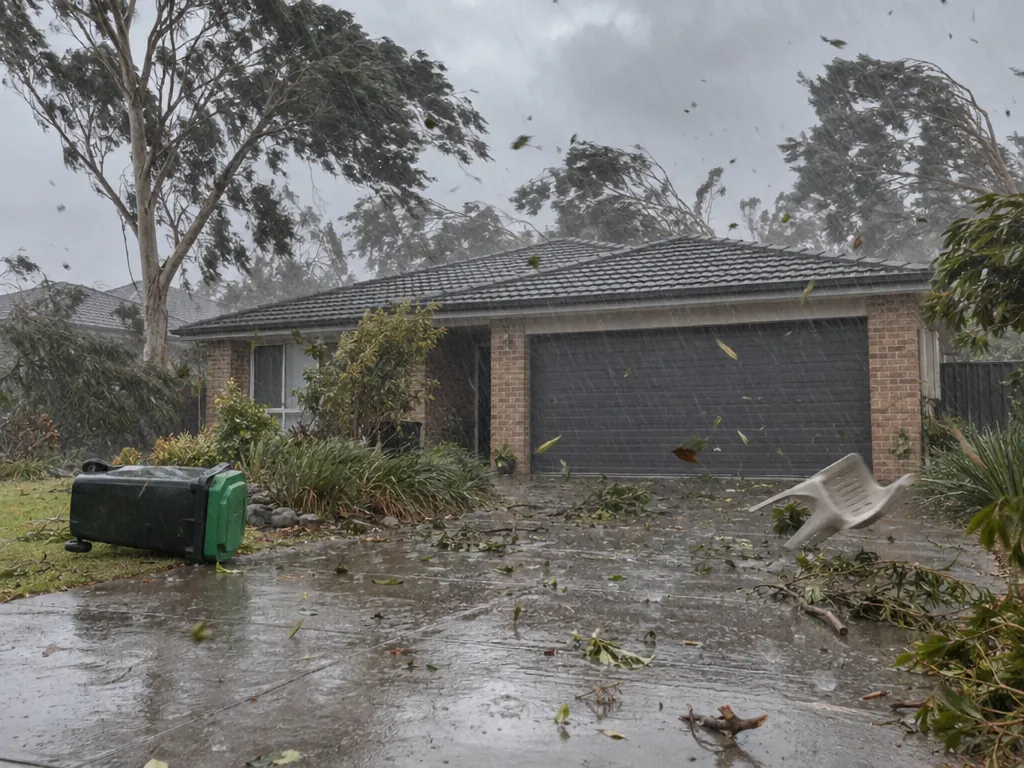
A garage door is the widest opening on the front of many homes, and wind pushes on the whole of it. The NCC's explanatory text on tying a house down in cyclonic areas says a building's ability to resist wind forces is directly related to its weakest link.
Debris is the other half of the problem. BoM lists dangerous airborne debris at Category 4. Queensland's guidance warns that loose outdoor items become dangerous missiles in high winds.
Garage doors get their own attention in cyclone guidance. The Queensland Reconstruction Authority's Cyclone Resilient Building Guidance covers garage doors alongside debris-rated screens, flashings and bracing. NEMA's library entry says modelling indicates it should reduce damage.
What does "tested" mean in practice? James Cook University's Cyclone Testing Station is NATA-accredited (no. 14937) and publishes a technical note on garage doors and other large access doors. It runs windborne-debris impact tests at up to 45 m/s, about 160 km/h, on components including roller doors. That figure is the impact speed of the test debris, not a wind speed, so it doesn't line up against the category table. A test result tells you how a product performed in a measured lab test. It does not promise how a door fares in any particular storm.
Does cyclone season reach the Hunter?
The official tropical cyclone season runs 1 November to 30 April, though BoM has recorded cyclones in May, June, July and October too. Since 2000 the average is 9 per season, and the first landfall usually comes in late December.
This season's headlines come from Queensland. In October BoM gave Queensland an increased chance of a severe cyclone, meaning Category 3 or above. One to two systems typically cross the Queensland coast each season. A BoM forecaster added that cyclones could also continue their move south.
For a Hunter home, the calendar that applies every year is the NSW one. NSW SES puts the storm season at September to April and says major storms can happen at any time of the year. BoM's own reminder holds here as well: it only takes one tropical cyclone or tropical low to have serious impacts. Treat that as a reason to know your door, not as a reason to panic.
How can I check my own garage door?
Five checks for your own door
Sources: Geoscience Australia, wind regions dataset; Queensland Government, cyclone and severe storm
Start with paper, not the forecast. Look for the door's documents from installation or from the house build, and note any standard or wind rating they name. Check the house plans for a wind region or class. If the paperwork is missing, the installer can tell you what the door was tested to.
Then know the warning steps. Queensland's guidance explains that a cyclone watch means cyclonic winds are expected within 24 to 48 hours, and a warning means within 24 hours. The same page says to secure loose outdoor items and to park vehicles under shelter or cover them firmly. A clear garage helps with both. Find the manual release now too, using our guide to the red cord.
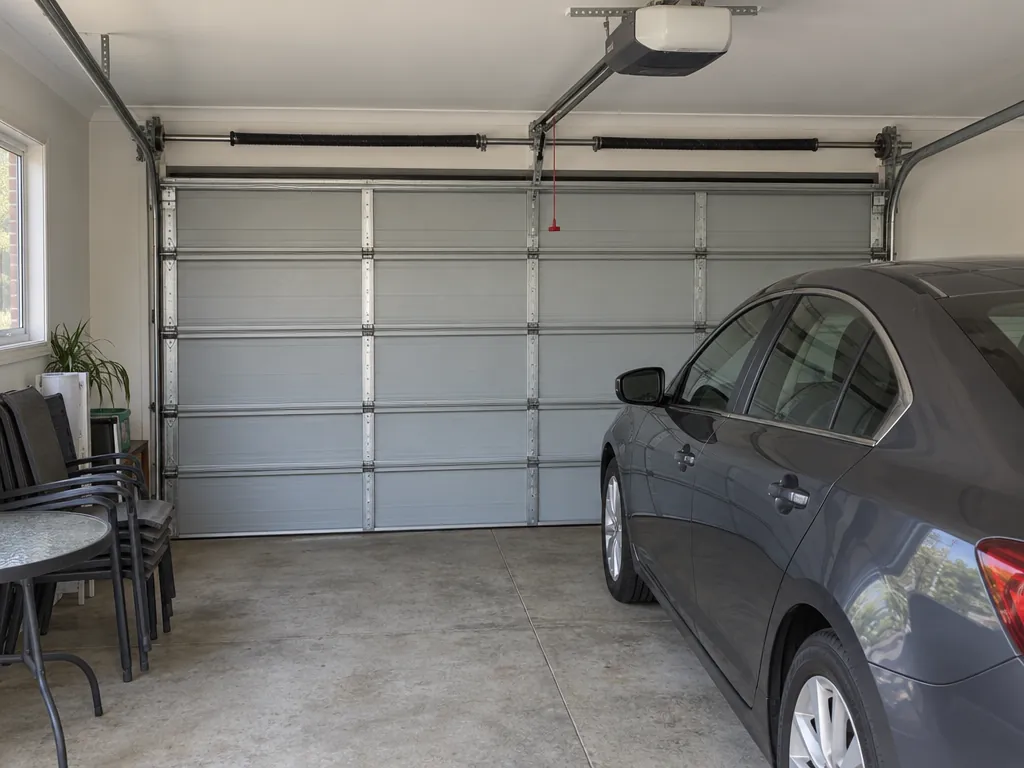
Here at Levee Garage Doors, the five checks in our Readiness Gauge are the quickest way we know to read a door yourself before you call anyone.
What are the numbers worth remembering?
The numbers worth remembering
- BoM Category 3:maximum mean wind 118 to 159 km/h; typical strongest gust 165 to 224 km/h; a rank for a storm, not a design wind.
Source: BoM, tropical cyclone categories
- NCC 2025 clause 2.2.4:AS/NZS 4505 for garage doors and other large access doors in openings up to 3 m high, in external walls in wind region B2, C or D.
Source: ABCB, NCC 2025
- NSW:NCC 2022 Amendment 2 applies until NCC 2025 is adopted; its clause lists region B, C or D.
Sources: ABCB, NCC 2022; NSW Building Commission
- Official tropical cyclone season:1 November to 30 April; NSW storm season September to April.
- JCU Cyclone Testing Station:windborne-debris impact tests at up to 45 m/s (about 160 km/h), the impact speed of the test debris.
Source: JCU Cyclone Testing Station
A Category 3 has a maximum mean wind of 118 to 159 km/h and typical gusts of 165 to 224 km/h, a rank for one storm's wind rather than a design wind. The NCC 2025 clause lists AS/NZS 4505 for garage doors in openings up to 3 m high in region B2, C or D, while NSW applies the NCC 2022 wording of region B, C or D for now. The season runs 1 November to 30 April, inside a NSW storm season of September to April.
Want a second opinion on your door?
Run the five checks, find your paperwork, and if something doesn't add up, or the door is sticking, rattling or straining, tell Levee Garage Doors what it's doing through our enquiry page. We'll take it from there with you.
Sources
- https://www.bom.gov.au/resources/learn-and-explore/tropical-cyclone-knowledge-centre/tropical-cyclone-categories
- https://www.bom.gov.au/news-and-media/helping-australia-prepare-for-severe-weather-season
- https://www.abc.net.au/news/2026-10-06/qld-severe-weather-outlook/107232308
- https://www.abcb.gov.au/editions/ncc-2025/adopted/housing-provisions/2-structure/part-22-structural-provisions
- https://www.abcb.gov.au/editions/ncc-2025/adopted/volume-one/b-structure/4-design-buildings-cyclonic-areas
- https://www.abcb.gov.au/editions/ncc-2022/adopted/housing-provisions/2-structure/part-22-structural-provisions
- https://www.nsw.gov.au/departments-and-agencies/building-commission/industry-changes
- https://hia.com.au/resources-and-advice/building-it-right/australian-standards/articles/wind-loads-for-housing
- https://ecat.ga.gov.au/geonetwork/srv/api/records/74dfa021-95cd-4090-9e25-a7a8efde5454
- https://www.jcu.edu.au/cyclone-testing-station/services
- https://www.nema.gov.au/our-work/resilience/national-resilience-action-library/cyclone-resilient-building-guidance-queensland-homes
- https://www.qld.gov.au/emergency/dealing-disasters/disaster-types/cyclone-severe-storm
- https://www.ses.nsw.gov.au/plan-and-prepare/storm